
A summer round in the Valley keeps you outside for four or five hours while the heat climbs, and the water you lose goes out slowly enough that most golfers never feel it leaving. The fix is not a drip before you tee off. It is a drinking plan that starts about two hours before your tee time, a steady cup every 15 to 20 minutes with a ceiling on how much, and a clear sense of which signs mean stop. An IV has a narrower job: the day the plan didn't work and you can't catch up by drinking.
What actually keeps a hot round safe?
A Hot Round Takes More Water Than You Notice, Even From a Cart
Golf doesn't feel like hard exercise, and that is part of the problem. The effort is low but it lasts for hours, in full sun, and the sweat adds up quietly. When 10 golfers played 18 holes at 30 to 33°C (86 to 91°F) with no fluid, they lost 3.8 percent of their body weight and finished with a core temperature of 39.4°C and a heart rate of 145. When the same men played with their fluid replaced, they finished at 38.6°C and 116 (Kobayashi and colleagues, 1996). Phoenix summer afternoons run hotter than that, though drier.
Riding doesn't fix it either. In a study of 16 golfers who drove carts around 18 holes at about 32°C (90°F), with as much chilled water as they wanted, players guessed they had sweated 1.2 liters. They had actually lost 2.1 (Passe and colleagues, 2003). Golfers also tend to start behind. Five of six collegiate golfers in one small study were already low on fluid before they hit a ball, and the authors note that professionals have reported drinking less on purpose to avoid hunting for a restroom (Stevenson and colleagues, 2019). In a larger sample of club and university athletes, golfers were one of the groups where more than 40 percent were dehydrated (Magee and colleagues, 2017).
It shows up in the game, too, though the studies are small. Seven low-handicap players who were mildly dehydrated, down about 1.5 percent of body weight, hit shorter and less accurate shots and misjudged distances to the target more than when they were well hydrated (Smith and colleagues, 2012). The lesson there is about keeping up with water, not about any product.
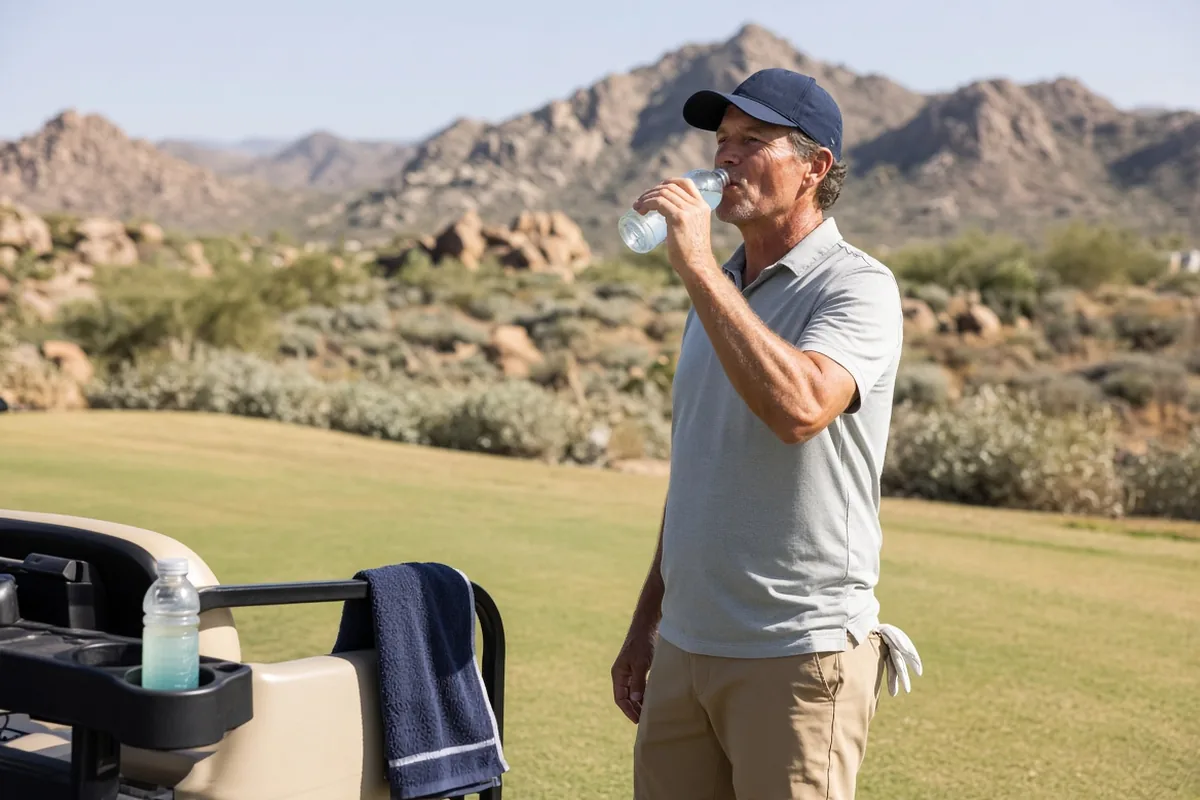
Start Drinking Two Hours Before the Tee Time
The amounts below come from sports-medicine and workplace heat guidance. Body size, pace and the day's heat all change how much you sweat, so treat them as a starting point, not a prescription.
- Two hours before. Drink about 500 ml (17 oz), ideally with a meal. That leaves time to absorb it and use the restroom before the first tee (American College of Sports Medicine).
- Every 15 to 20 minutes on the course. About a cup (8 oz) each time. A few swallows at every tee box spreads it out the way the guidance intends, instead of a whole bottle at the turn (CDC heat stress guidance).
- Past the first hour. Make some of it a sports or electrolyte drink. When sweating goes on for hours, you lose sodium along with water, and the guidance shifts from plain water to drinks with electrolytes.
- Know the ceiling. Stay under about 6 cups an hour. More is not better: drinking far past what you sweat can dilute the sodium in your blood, a separate and serious problem (National Athletic Trainers' Association).
- After the round. Keep drinking with food until your urine is pale yellow, a practical sign you have caught up (ACSM hydration roundtable).
Book the 4 to 7 A.M. Window When You Can
The National Weather Service office in Phoenix puts the coolest part of a summer day usually between 4:00 and 7:00 a.m., which is why the first tee times of the morning are worth chasing. The same office notes that heat deaths in Arizona can happen with temperatures in the mid 80s and hotter (NWS Phoenix). A warm spring or fall afternoon round still counts as heat.
How you arrive matters as much as when. In a survey of amateur golfers in Japan, feeling dehydrated before playing, short sleep and a poor appetite were each linked with heat-exhaustion symptoms on the course (Nagashima and colleagues, 2025). For a 6 a.m. tee time, the plan starts the night before: a real dinner, enough sleep and water, so you are not trying to catch up on the first hole.
Heat Signs That Mean Stop, and the Ones That Mean Call 911
On a course, the risk is the urge to finish the hole, then the nine, then the round. These are the National Weather Service's lists (NWS).
Heat exhaustion: stop playing and cool down
- Heavy sweating
- Weakness or tiredness
- Cool, pale, clammy skin
- A fast, weak pulse
- Muscle cramps
- Dizziness, nausea or vomiting
- Headache
- Fainting
Get into an air-conditioned clubhouse or the shade, loosen clothing, put cool wet cloths on the skin and take sips of water. Get medical help right away if the person vomits, gets worse, or is not better within an hour.
Heat stroke: call 911
- Confusion or slurred speech
- A throbbing headache
- Body temperature above 103°F
- Hot, red skin, dry or damp
- A rapid, strong pulse
- Fainting or loss of consciousness
Call 911. Move the person somewhere cooler and cool them with wet cloths or water. Do not give them anything to drink. Stay with them and keep cooling until help arrives, following the first 10 minutes of heat first aid.
When Is an IV Worth It After a Round?
Less often than the ads suggest. In controlled studies, IV fluid brought blood volume back faster than drinking did, but it did not lower heat strain or improve exercise afterward any better than drinking the same fluid (Kenefick and colleagues, 2006; van Rosendal and colleagues, 2010). In a 2026 study, recreationally active men who drank during exercise in the heat finished a time trial faster and ran cooler than when the same fluid went in by IV (Sekiguchi and colleagues). If you can drink and keep it down, the plan above is the plan, and the speed and cost differences in how an IV compares with drinking don't change that.
Where an IV does fit is later, after a bad day: you are alert, the heat-illness signs above have passed, but you are still wiped out and drinking isn't working, because you're queasy and water won't stay down, or you have another early tee time and you're starting from behind. Vomiting during or right after heat exhaustion is the medical-help case above, not a reason to book an IV. An IV puts the fluid straight into the bloodstream and bypasses digestion entirely, which is the point when your stomach is the thing holding you back.
We come to your home, hotel or office anywhere in the Valley, so nobody has to drive across town in the heat while feeling like that. Every IV is started by a licensed nurse or REMT, under the medical direction of Dr. Christopher Seitz, MD, a board-certified emergency physician. Prices are fixed and published. Add-ons are $25 each, and visits between 8:00 PM and 7:00 AM carry a $99 after-hours fee.
Hydration IV · $175 · about 45 minutes. One liter of normal saline with vitamin C, a B-complex and B12. Book a Hydration IV at home if you want the vitamins included.
IV Fluids · $150 · about 35 minutes. One liter (1000 ml) of IV fluids with nothing added. If all you need is the fluid back, plain IV fluids are the simplest option.
Golfers' Questions About Playing in the Heat
Is riding a cart enough protection on a hot day?
A cart saves you the walking and its roof gives some shade, but it doesn't shorten the round or cool the air, and you still sweat the whole time. The cart riders in the study above lost almost twice what they thought they had. Ride when it's hot, and still follow the drinking plan from two hours before the tee time.
What temperature is too hot to play golf?
There isn't one safe number. The Phoenix weather office notes that heat deaths in Arizona can occur from the mid 80s, and humidity, sun and your own health shift the line. Watch for National Weather Service heat warnings, move to the earliest tee time on hot days, and treat the signs above as the real limit.
Do beer and coffee on the course count toward my fluids?
Coffee and other caffeinated drinks do count toward your daily water, according to the National Academies' water report. Caffeine and alcohol can both raise urine output a little, though, so neither replaces the water plan. If you're having a beer at the turn, keep a cup of water going beside it.
Water or a sports drink for 18 holes?
For the first hour, water is fine. A round lasts much longer than that, and once you've been sweating for hours the guidance shifts toward drinks with electrolytes, because you're losing sodium as well as water. Splitting your cups between water and an electrolyte drink is a simple way to cover both.
Can an IV the night before an early tee time help?
For a healthy golfer who can drink, the studies above don't show an IV doing more than drinking would. If you're alert, free of the heat-illness signs above, but queasy and can't keep fluids down the night before, that's a different situation, and an IV is a reasonable way to get fluid in. A visit after 8:00 PM carries the $99 after-hours fee.
I'm sore and wiped out the day after a hot round. What helps?
Rest, real meals and steady fluids do most of the work. Soreness after a long round in the heat calls for the same basics as recovering after a hard desert workout. A tournament week or a practice block puts you closer to an athlete in training, the schedule IV therapy for athletes in training is written around.
Sources
- Kobayashi Y, et al. Heat stress and fluid replacement in golfers. 1996. doi.org/10.7600/jspfsm1949.45.119
- Passe DH, et al. Perceived sweat loss is related to mood state in golfers. Medicine & Science in Sports & Exercise, 2003. doi.org/10.1097/00005768-200305001-00770
- Stevenson W, Zabinsky JS, Hedrick VE. Effects of dehydration on cognitive and physical performance in female golfers. J, 2019. doi.org/10.3390/j2040032
- Magee PJ, Gallagher AM, McCormack JM. High prevalence of dehydration and inadequate nutritional knowledge among university and club level athletes. International Journal of Sport Nutrition and Exercise Metabolism, 2017. doi.org/10.1123/ijsnem.2016-0053
- Smith MF, et al. Effect of acute mild dehydration on cognitive-motor performance in golf. Journal of Strength and Conditioning Research, 2012. doi.org/10.1519/jsc.0b013e318245bea7
- American College of Sports Medicine. Position stand: exercise and fluid replacement. Medicine & Science in Sports & Exercise, 2007. doi.org/10.1249/mss.0b013e31802ca597
- CDC, NIOSH. Workplace recommendations: heat stress. cdc.gov
- McDermott BP, et al. National Athletic Trainers' Association position statement: fluid replacement for the physically active. Journal of Athletic Training, 2017. doi.org/10.4085/1062-6050-52.9.02
- Casa DJ, Clarkson PM, Roberts WO. ACSM roundtable on hydration and physical activity. Current Sports Medicine Reports, 2005. doi.org/10.1097/01.csmr.0000306194.67241.76
- National Weather Service, Phoenix. Heat. weather.gov/psr/heat
- National Weather Service. Heat cramps, exhaustion, stroke. weather.gov/safety/heat-illness
- Nagashima Y, et al. Associated factors for exertional heat exhaustion-related symptoms among amateur golfers in Japan. Temperature, 2025. doi.org/10.1080/23328940.2025.2508489
- Kenefick RW, et al. Rapid IV versus oral rehydration. Medicine & Science in Sports & Exercise, 2006. doi.org/10.1249/01.mss.0000235358.39555.80
- van Rosendal SP, et al. Intravenous versus oral rehydration in athletes. Sports Medicine, 2010. doi.org/10.2165/11319810-000000000-00000
- Sekiguchi Y, et al. Oral rehydration improved exercise performance and decreased core temperature and heart rate compared with intravenous rehydration in recreationally active men. Sports Health, 2026. doi.org/10.1177/19417381261434047
- Institute of Medicine. Dietary Reference Intakes for Water, Potassium, Sodium, Chloride, and Sulfate. National Academies Press, 2005. doi.org/10.17226/10925
Where We Come To You
Visits at your home, hotel or office across the Phoenix metro.