
A Scottsdale trip tends to pack a lot of outdoors into one day. A sunrise trail in the McDowell Sonoran Preserve, a tee time before lunch, an afternoon by the pool, dinner in Old Town. During hard activity, the National Weather Service notes, the body can lose up to four liters of water an hour. What keeps you ahead is a schedule set before each block, a ceiling so you do not overcorrect, one check you can read yourself, and knowing the signs where more water stops being the answer.
What does keeping up look like on an active day?
- Why a Scottsdale trip catches people out
- A trail morning, by the city's own numbers
- A round of golf is a long sweat
- What the drinks by the pool actually do
- How can you tell you are keeping up?
- When it is no longer about water
- If you fell behind but are not sick
- Questions visitors ask about water in the desert
- Sources
Why a Scottsdale trip catches people out
The risk is rarely one hot hour. It is three or four outdoor blocks stacked into the same day while thirst runs behind you. Thirst is a late signal, which is why the National Weather Service in Phoenix tells people to carry water and drink even if they do not feel thirsty.
The calendar adds to it. Most visitors come between October and May, when the Valley is full of events: the WM Phoenix Open at TPC Scottsdale in early February, spring training from late February to late March, and pool season ramping up in April. Those months are milder, but the days are just as full. Then from May to about September, the city warns, temperatures reach triple digits almost every day. The plan below works in either season. Summer simply leaves less room for error.
A trail morning, by the city's own numbers
The City of Scottsdale publishes its own water schedule for the McDowell Sonoran Preserve. Followed in order, it looks like this:
- The night before. Start drinking. The city's advice is to begin hydrating before your outing, even the night before.
- Two hours before. Drink at least two cups of water.
- Start early. Preserve gates open roughly 30 minutes before sunrise. The National Weather Service puts strenuous activity in the coolest part of the day, which in summer is usually between 4 and 7 a.m.
- On the trail. Drink about five ounces every 15 minutes, whether or not you feel thirsty.
- At the halfway point of your water. When half of what you carried is gone, turn around, even if you have not reached the top.
- After. Rehydrate with electrolytes and water, not water alone.
The turnaround rule matters most. It treats the water you carry as the limit on the hike, which is the right way round in the desert.
A round of golf is a long sweat
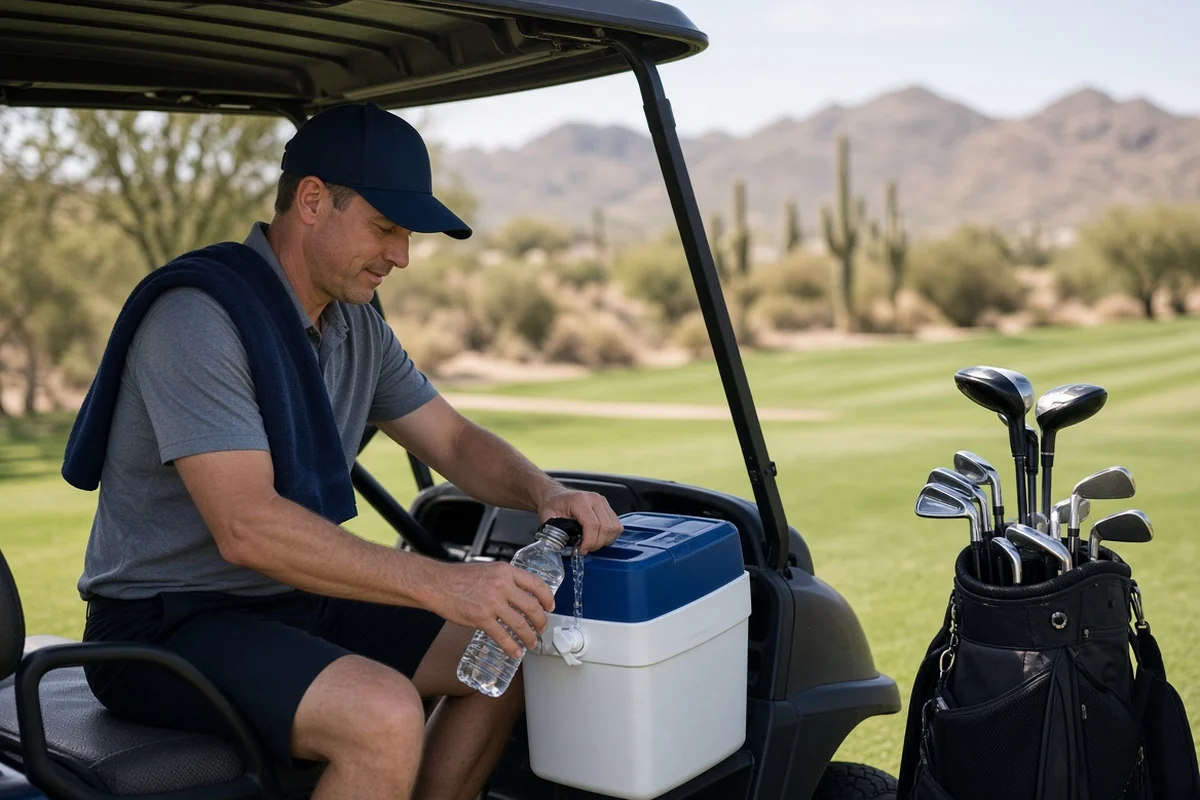
Eighteen holes usually run well past two hours, and two hours is where the guidance changes. For moderate activity in the heat that lasts less than two hours, the CDC's workplace heat guidance (NIOSH) is about one cup, eight ounces, every 15 to 20 minutes. Once sweating goes on for several hours, it adds a sports drink with balanced electrolytes, because you are losing salt along with the water.
The same guidance sets a ceiling: generally, no more than six cups an hour. A schedule matters more than volume. Drinking steadily from the first tee keeps you inside that limit; trying to catch up on the back nine pushes you past it. Use the turn and the shade of the cart as real breaks, which the Weather Service also recommends on warm days.
What the drinks by the pool actually do
In controlled trials, alcohol's effect on hydration has been small and short-lived, and that still does not make a pool day of drinks a good plan. In a controlled trial, a moderate dose of alcohol (30 grams) taken as wine or spirits raised urine output over the next four hours compared with the same drinks without alcohol. The same dose as beer did not, and by 24 hours there was no difference for any of them. That trial studied older men, so treat it as a guide rather than a rule. In a separate trial of 13 common drinks, lager, coffee, tea and cola left people no more or less hydrated than water over four hours, while milk and an oral rehydration solution stayed in the body longer.
The bigger problem is what the drink replaces. A cocktail in the afternoon sun stands in for the water you would otherwise drink, for hours at a time. The Weather Service's advice is to avoid alcohol in the heat. If you are drinking anyway, alternate each one with a glass of water and keep a bottle on the lounger.
How can you tell you are keeping up?
Do not wait to feel thirsty. The easiest check is the color of your urine: pale yellow means you are keeping up, dark yellow means you are behind. A systematic review found urine color a valid, practical hydration check for adults and athletes, though it tracked less closely in adults over 60.
Your body also gives early warnings that heat is getting the better of you. Muscle cramps, fatigue, strong thirst and very heavy sweating are among the first signs of heat illness, according to MedlinePlus. Treat any of them as a reason to stop, get into shade or air conditioning, and drink.
When it is no longer about water
These two pictures come from the National Weather Service. They call for different things, and the second one is an emergency.
Heat exhaustion
- Signs: heavy sweating; weakness or tiredness; cool, pale, clammy skin; a fast, weak pulse; muscle cramps; dizziness, nausea or vomiting; headache; fainting.
- What to do: move to a cooler place, ideally air conditioned. Loosen clothing, apply cool, wet cloths or sit in a cool bath, and take sips of water. Get medical help right away if the person vomits, the symptoms get worse, or they last longer than an hour.
Heat stroke
- Signs: a body temperature above 103°F; confusion or slurred speech; hot, red, dry or damp skin; a rapid, strong pulse; a throbbing headache, nausea or dizziness; fainting or loss of consciousness.
- What to do: call 911 or get to a hospital immediately. Move the person somewhere cooler and lower their temperature with cool cloths or a cool bath. Do not give them fluids to drink.
For the fuller comparison with the everyday tiredness the heat causes, see how heat exhaustion differs from ordinary heat fatigue.
If you fell behind but are not sick
Sometimes the plan slips: a long day outside, a late night, a morning when you never caught up. If you have none of the signs above, start with water or an oral rehydration drink first. For most people that is enough.
If you would rather not leave your room to deal with it, a licensed nurse or REMT can bring fluids to you. We send a nurse to your Scottsdale hotel or rental, or to a home anywhere in the city. The Hydration IV is one liter of normal saline with vitamin C, B-complex and B12. It takes 45 minutes and costs $175. It is not for anyone showing the heat-illness signs in the section above. That calls for medical care, not a drip at the hotel.
Questions visitors ask about water in the desert
Can you drink too much water on a hot day?
There is a sensible upper limit. The CDC's workplace heat guidance says fluid intake should generally not exceed six cups an hour. The safer habit is a steady schedule from the start of the activity rather than large amounts at the end. If you find yourself trying to catch up by drinking quickly, slow down, rest in the shade and spread it out.
Should I take salt tablets for a hike or a round of golf?
The National Weather Service in Phoenix advises against salt tablets unless a physician has told you to use them. For long sweaty stretches, the CDC's heat guidance points to sports drinks with balanced electrolytes instead, which give you salt and fluid together. The City of Scottsdale gives the same advice for after a hike: electrolytes and water.
Do coffee and iced tea count toward my water?
In a controlled trial, coffee and tea left people about as hydrated as the same amount of water over four hours, so a morning coffee is not working against you. The CDC's heat guidance still suggests avoiding drinks high in caffeine or sugar while you are working hard in the heat, so keep water as your main drink outdoors.
Who in a travel group needs a closer eye?
Young children and infants need much more frequent watching in the heat, according to the National Weather Service, so check on them more often than you would check on yourself. For travelers over 60, urine color is a less reliable check than it is for younger adults, so a steady drinking schedule matters more than waiting for a signal.
Can I bring my dog on a Scottsdale trail?
The City of Scottsdale asks visitors to check the hourly forecast first and to leave dogs at home if it will be more than 90 degrees during the outing. Dogs cannot regulate heat as effectively as people do, and the city notes that the desert heat can kill them with little or no warning.
Sources
- City of Scottsdale, McDowell Sonoran Preserve: hiking safety and heat guidance. www.scottsdaleaz.gov
- CDC, NIOSH, “Workplace Recommendations: Heat Stress.” www.cdc.gov
- National Weather Service Phoenix, “Heat Safety.” www.weather.gov
- National Weather Service, “Heat Illness.” www.weather.gov
- MedlinePlus, “Heat emergencies.” medlineplus.gov
- Kostelnik SB, et al. “The Validity of Urine Color as a Hydration Biomarker within the General Adult Population and Athletes: A Systematic Review.” Journal of the American College of Nutrition, 2021. doi:10.1080/07315724.2020.1750073
- Polhuis KCMM, et al. “The Diuretic Action of Weak and Strong Alcoholic Beverages in Elderly Men: A Randomized Diet-Controlled Crossover Trial.” Nutrients, 2017. doi:10.3390/nu9070660
- Maughan RJ, et al. “A randomized trial to assess the potential of different beverages to affect hydration status: development of a beverage hydration index.” American Journal of Clinical Nutrition, 2016. doi:10.3945/ajcn.115.114769